Friday, February 4, 2011
Works Cited
"M61 Vulcan." Wikipedia, the Free Encyclopedia. 27 Jan. 2011. Web. 01 Feb. 2011. .
"Mauser BK-27 - Definition." Dictionary, Encyclopedia and Thesaurus - WordIQ Dictionary. 2010. Web. 29 Jan. 2011. .
"Parrott Rifle." Wikipedia, the Free Encyclopedia. 19 Jan. 2011. Web. 30 Jan. 2011. .
"Jaivana." Wikipedia, the Free Encyclopedia. 14 Jan. 2011. Web. 1 Feb. 2011. .
"Fire Lance." Wikipedia, the Free Encyclopedia. 4 Jan. 2011. Web. 19 Jan. 2011. .
"Trebuchet." Wikipedia, the Free Encyclopedia. Web. 24 Jan. 2011. .
"Weapon of Mass Destruction." Wikipedia, the Free Encyclopedia. Web. 02 Feb. 2011. .

Thursday, February 3, 2011
Weapons of Mass Destruction (WMD)
A weapon of mass destruction is defined as a weapon that can "bring significant harm to a large number of humans (and/or other life forms) and/or cause great damage to man-made structures, natural structures or the biosphere in general." There are four classifications of WMD's.
Biological
Chemical
Nuclear
Radiological
Biological weaponry often uses diseases or harmful substances (such as anthrax) to bring harm to a large number of people.
Chemical warfare uses chemicals to bring harm to a large number of people (such as chlorine and cyanogen chloride).
Nuclear warfare uses nuclear reactions to bring harm to a large number of people. For example, a nuclear bomb uses a small chain of nuclear reactions from large quantities of energy and relatively small amounts of matter.
I don't agree with any type of weapon of mass destruction. That is potenially taking the life of someone who you don't even know. They are human just like you and I believe all humans have the right to live.
English Component
In the book "A Long Way Gone" by Ishmael Beah, he doesn't detail cannons as a weapon he used that much. He mainly used AK-47's, grenades and knives. However, those guns and cannons I believe would have had the same effect on him. Guns and war tore him apart from his family, and I think cannons would have done the same thing, if not worse. Guns made him mentally unstable, forcing him to rely on arms to keep him alive at the ages 12 to 15. No teenager should have to go through that sort of thing just to stay alive, including taking another human life or taking drugs.
Science Component
The balanced equation for ethanol and oxygen.
C2H5OH+3O2->2CO2+3H2O
We chose a 43 degree angle because when we did preliminary research on optimal angles to fire a cannon, some sources said 40 degrees, some said 45 degrees, so we settled in the middle at 43.
The gas law that is used in this experiment is Gay-Lussac's law. Gay-Lussac's law states that pressure and temperature are directly proportional.
Pressure One times Temperature One equals Pressure Two times Temperature Two. Whatever unit is missing you solve for by isolating it.
 A chart with different projections of the angles

Math Component
A cannonball is shot upward from the upper deck of a fort with an initial velocity of 192 feet per second. The deck is 32 feet above the ground.
Quadratic Model: h = -16t2+192t+32
How high does the cannonball go? 608 feet
How long is the cannonball in the air? 12.16 seconds
1. Plug 192 feet per second in for v0 and 32 feet for h0
2. Plug formula into calculator and graph
3. Go to the table and find the vertex of the graph (this is how high the cannonball went)
4. Using the quadratic formula, find the positive x-intercept (this is how long the cannonball was in the air)
5. Check your work
Cannons 1800-1900: Parrot Rifle
The parrot rifle is a combination of cast and wrought iron. Cast iron made it good when it came to accuracy, but also left it vulnerable to cracks due to its brittleness. Parrot rifles were manufactured in different sizes, from 10 to 300 lbs. The most common in the fields, with 20 pounders being used by both the Union and the Confederacy during the Civil War. Naval versions of the parrot rifles ranged from 20-100 lbs. The 100 pound cannon had a range of 6900 yards. That’s 69 football fields. It was easier and cheaper to make than other cannons, although it did posses a safety risk.

Cannons Pre 1800: Trebuchet
Another cannon that was made before the year 1800 was the trebuchet. The trebuchet was first developed in China in the 5th centruy, B.C. It mainly consisted of a sling and a lever, and a counterweight. The counterweight was suspended in air, sorta like a seesaw. When the counterweight dropped, the sling would loop over and fling the projectile forward.
Trebuchets were very effective when it came to attacking and defending. It could fling a two-hundred pound object three hundred yards. That's the equivalent of three football fields. The range that it could fire warded off enemies and gave space to the people using it. Also, it was effective in developing biological warfare, i.e. flinging dead, infected and rotting corpses into towns and villages in order to scare the people into surrendering.

Jaivana Cannon
Cannons 1800-1900: Jaivana Cannon
The Jaivana cannon is the world’s largest cannon on wheels. It is located at Jaigarh Fort in Jaipur, which is the capital of the Indian state of Rajasthan. The barrel is 20 feet long and weighs 50 tons. That’s the equivalent of a Right Whale.
Reportedly it took four elephants to swivel it around. A water tank was kept beside the cannon so the gunner (the person who was operating the cannon) could jump into it, to prevent the gunner from feeling the shockwave that the cannon blast would cause. Well the gunner for the Jaivana Cannon was said to have died on the spot because he couldn't jump into the water tank in time.
 (A right whale)
 (Jaivana Cannon)
Mauser BK-27
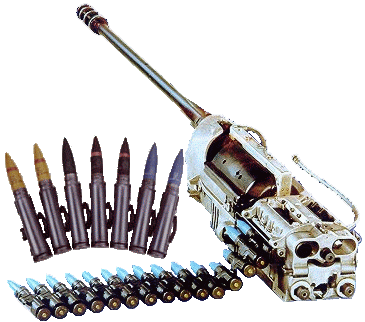
The Mauser BK-27 is a 27 millimeter revolver cannon developed by Mauser in Germany. It was made in the late 1960s for the Multi Role Combat Aircraft (MRCA) program. The BK-27 has a high muzzle velocity and link-less feed system and can fire at either 1,000 or 1,700 rounds a minute, which is good, but not nearly as fast as the M61 Vulcan. It has a very good hit-accuracy and the targeting is done in the aircraft’s HUD (Head-Up Display). Also, it has the ability to fire several different types of shells, which makes it good for both aerial and ground attacks.
Monday, January 31, 2011
Cannons Post 1900: M61 Vulcan
The M61 is a hydraulically driven, six barreled, air cooled, and electrically powered Gatling style-cannon. It is the main cannon attachment for U.S. fixed wing aircraft, and has been for the past 50 years.
The M61 was developed after World War II as the brainchild of the United States Army. They began to think of the future of military aircraft guns. Their plan: to combine an extremely high rate of fire with exceptional reliability. The problem was that the high speeds of a jet-engine fighter aircraft would make it much more difficult without a much higher volume of fire. It was inspired by the designs of the Mauser MG213C, among other German guns.
In 1946, the Army issued General Electric Armament Division a contract for what was called “Project Vulcan”. It was to be a six-barreled weapon capable of firing 6,000 rounds per minute. The first aircraft to adopt this cannon was the F-104 Starfighter.
The M61 did suffer problems with the linked ammunition, as it was prone to foreign object damage and misfeed. They corrected it with a linkless feed system for the newer M61A1, which became the standard armament of U.S. fighter aircraft.
Social Impact of Cannons
Cannons revolutionized the way people fought and defended. Once impenetrable castle walls and citadels that took months, even years to conquer were now easier to capture. Towns were now more vulnerable to successful sieges and raids. Cannons forced castle architects to go back to the drawing board, both literally and figuratively, and redesign castle walls because the walls were tall, flat and easy targets for the cannons. Many responded by thickening castle walls with piles of dirt called ramparts. Most of the time, ramparts were proven to be ineffective because they weakened the building material rather than strengthening it. Others dug deeper and wider moats or had rounded walls built. Rounded walls were created to try to make a “glancing shot” rather than a direct hit that a flat wall would end up taking, and were effective designs. The negative of rounded walls was that they were often too expensive for villages/towns/cities to build.
Leon Battista Alberti, an Italian author, artist and architect, among other things, wrote the De re aedificatoria, which were five requirements that castles would need to meet in order to successfully defend against cannon attacks. These were:
Leon Battista Alberti, an Italian author, artist and architect, among other things, wrote the De re aedificatoria, which were five requirements that castles would need to meet in order to successfully defend against cannon attacks. These were:
1) Fortification walls facing gunpowder weapons should be both short enough to easily see the ground below them, and wide enough to withstand the impact of cannonballs.
2) Artillery towers projecting at an angle beyond the walls should be added to the fortification- this would not only protect the fortification itself but also keep offensive guns at bay and cover blind spots along the fortress walls,
3) Angled bastions projecting out at regular intervals from the fortress wall should be built, giving increasing flanking cross-fire along the surface of those walls,
4) As time passed, further refinements should be added to the fortification: wide and deep ditches along the walls to keep enemy artillery at a distance and to cut down on mining with detached bastions built beyond those ditches to further impede enemy artillery attacks, and
5) Extensions should be built to these fortifications, complete with crownworks or hornworks, to protect these outside strategic areas.
Thursday, January 20, 2011
Cannons Pre 1800: Fire-lance: The "Father" of the Cannon
The beginning of the cannon dates back to the 10th century. Cannons were the descendants of the fire-lance (or the firespear), which was a Chinese spear attached to a bamboo tube with gunpowder inside the chamber. These shot poison darts and small projectiles with fire.
Originally used for hand to hand combat, the gunpowder was designed to give an edge to the user in close combat. Inventors soon saw the opportunity due to the chamber/gunpowder design to make it into what it became. It saw the most use during the early Song Dynasty. It was good for:
shooting enemies trying to scale walls
holding an enemy at bay
Also, the fire-lance was very effective when it was fired in volleys.
The fire lance is often remembered for paving the way for the development of not only cannons, but for firearms and other artillery.
Originally used for hand to hand combat, the gunpowder was designed to give an edge to the user in close combat. Inventors soon saw the opportunity due to the chamber/gunpowder design to make it into what it became. It saw the most use during the early Song Dynasty. It was good for:
shooting enemies trying to scale walls
holding an enemy at bay
Also, the fire-lance was very effective when it was fired in volleys.
The fire lance is often remembered for paving the way for the development of not only cannons, but for firearms and other artillery.
Subscribe to:
Posts (Atom)